
Youth Study

Phase II of the Collective’s needs assessment project, a participatory action research (PAR) initiative, helps better identify the health and well-being needs of teens aged 14 to 18.

Youth Study Results

About a hundred people—leaders and managers from both the Francophone and immersion school systems, as well as the community, health, and social services sectors—gathered on June 13, 2024, at Université de Saint-Boniface (USB) to hear a first look at the research findings during an evening organized and hosted by the youth research team.

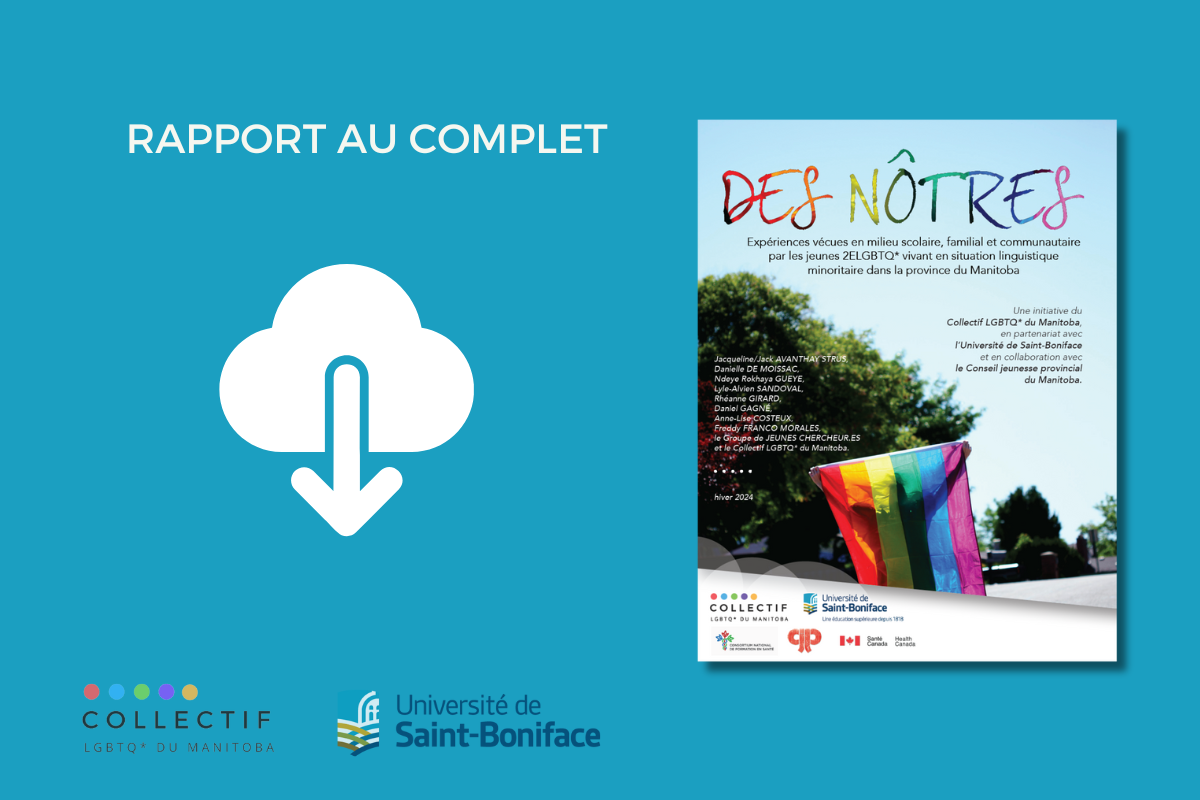
Titled One of Us: Lived Experiences in School, Family, and Community Settings of 2SLGBTQ* Youth Living in a Linguistic Minority Situation in the Province of Manitoba (PDF), the research report reveals the challenges and needs of French-speaking 2SLGBTQ+ youth in Manitoba, highlighting difficulties with inclusion in school, family, and community settings. The study emphasizes the absence of support networks in French, the difficulty in finding safe spaces, and the need for inclusive policies and adequate support. Recommendations were made to promote inclusion, raise awareness of the specific needs of 2SLGBTQ+ youth, and create respectful and safe environments, while calling for community initiatives and professional training.
Knowledge Sharing

Download One of Us: Lived experiences at school, at home, and in the community among 2ELGBTQ* youth living in a minority-language context in the province of Manitoba (PDF)

Download the Research report summary (PDF)

the infographic produced by the young researchers Lived Experiences of Francophone 2SLGBTQ* Youth Living in a Linguistic Minority Situation in Manitoba (PDF)

The research was conducted by a team of 6 to 10 young researchers with the support of researcher Jacqueline Avanthay Strus from Université de Saint-Boniface (USB) and an advisory committee. The Youth Study consisted of three components in total.

Why explore teens’ experiences?

Following the results of Phase I, the Collectives board of directors chose 2SLGBTQ+ adolescents as a priority for the next phase of the needs analysis project. Indeed, young people are more vulnerable to mental health problems due to the multiple physical, emotional, and social changes they experience during this period of their lives when lifestyle habits, interpersonal relationships, and emotion management are developing.

Some social factors can further increase the risk of health problems among young people, in particular:

  • being from linguistic or sexual minorities;
  • being subjected to stigma or discrimination; and
  • lack of access to support in their language.

In Manitoba, there is limited access to mental health services in French (Prada et al., 2021). And even when these services are available, young people often do not use them because they are unaware of their existence, preferring to confide in those close to them or not talk to anyone. This can contribute to an increase in mental health problems and, in turn, have a negative effect on learning and social integration in high school and during the transition to post-secondary settings.

Among young people in the Francophone community, 2SLGBTQ+ adolescents and young adults are particularly at risk due to unsympathetic and phobic attitudes in school or family settings. Studies show that the trauma experienced during adolescence can, for many, persist throughout their lives, with a decisive impact on their general and mental health.

This study sought to answer the following questions:

  • How does having multiple identities influence the experiences of French-speaking 2ELGBTQ+ youth?
  • What are the experiences of young people in school settings, within their families, in the community, and with social and health services, before, during, and after their disclosure (coming out)? How do needs in rural and urban settings differ?
  • What services exist for French-speaking 2ELGBTQ+ youth in Manitoba? To what extent are these services adapted to the multiple identities of French-speaking 2ELGBTQ+ youth?
  • What services or supports do 2ELGBTQ+ youth need at school, at home, and in the community?

A three-part study

Any school intervention aimed at a positive outcome must take into account the interests of three groups: those of students, those of parents, and those of teaching staff. For this reason, the research team chose to survey students, parents, and teaching staff as part of the Youth Study.

During the first component, which took place from November 24 to December 15, 2022, Francophone youth aged 14 to 22 who identified as a member or ally of a sexual minority (2ELGBTQ+) had the opportunity to share their experiences through a questionnaire, an individual or group interview, or a written or artistic submission.

Subsequently, adults were invited to participate in the second and third components. Parents or guardians of adolescents could then participate in interviews or focus groups during the second component. Teachers, teaching assistants, and counselors working or having worked with Francophone 2SLGBTQ+ youth could participate in the third component, also through interviews or focus groups.

The Youth Study will result, we hope, in greater interest in developing training and support programs in educational settings and in administrators of secondary and post-secondary educational institutions recognizing the need for interventions in these settings, particularly for 2SLGBTQ+ youth who are more vulnerable. Finally, the results will allow the Collective to take into account the specific needs of young people in the evaluation and implementation of health or wellness services for the French-speaking 2SLGBTQ+ community in Manitoba.

PAR methodology

Participatory action research (PAR) is an approach based on a genuine partnership between researchers and the community. Likewise, community members actively participate in the research process—from defining the research objectives to sharing new knowledge, including research planning, data collection, and interpreting results, among other steps. Through this partnership, PAR seeks to integrate the experiential knowledge (lived experience) of people who, ultimately, will benefit most from the research outcomes with scientific knowledge. In short, this methodology aims for the “co-construction” of knowledge.

Active involvement of community members in research helps achieve several goals. First, it helps better align research with the needs and priorities of community members, making it easier to apply new knowledge. Investing in a research project also means taking ownership of the research results: it is the empowerment of adolescents and young adults in the French-speaking 2SLGBTQ+ community of Manitoba that is therefore promoted by Phase II of the needs analysis project.

Research Team

The research team is composed of 6 to 10 young people from the French-speaking 2SLGBTQ+ community with the support of:

  • Jacqueline Avanthay Strus, professor of nursing, Université de Saint-Boniface (sexuality and harm reduction, vulnerable populations, Indigenous health), and guidance from the advisory committee (see below).

Advisory committee

The Youth Study research was guided by an advisory committee made up of members of the research team, members of Manitoba’s French-speaking 2ELGBTQ+ community, as well as allies:

  • Jacqueline Avanthay Strus, professor of nursing, Université de Saint-Boniface (sexuality and harm reduction, vulnerable populations, Indigenous health);
  • Derrek Bently, Provincial Youth Council (PYC)
  • Jay Campagne, Manitoba LGBTQ* Collective
  • Anne-Lise Costeux professor, School of Nursing and Health Studies, Université de Saint-Boniface (cultural safety in an Indigenous context)
  • Christian Delaquis, Manitoba LGBTQ* Collective
  • Danielle de Moissac, Professor, Université de Saint-Boniface (health services, mental health and society, risk behaviors, determinants of health)
  • Jacques Desaulniers, Manitoba LGBTQ* Collective
  • Daniel Gagné, Professor and Dean of the School of Nursing and Health Studies, Université de Saint-Boniface (oncology, family, quality of life)
  • Ndeye Rokhaya Gueye, Professor, Université de Saint-Boniface (statistics, population health, minority health, mental health and addiction)
  • Stephan Hardy, Collectif LGBTQ* du Manitoba
  • Marie-Claude McDonald, Division scolaire franco-manitobaine (DSFM).

Our Partners

In addition to the Université de Saint-Boniface (USB) researchers involved in the work, several partners contributed to Phase II of the Collective’s needs assessment project by providing financial or in-kind resources. The Collective would like to thank them for their unwavering commitment to Manitoba’s 2ELGBTQ+ community.

To learn more about the Youth Study, or to get in touch with the research team, email us at info@collectiflgbtq.ca.

Subsequent phases of the needs analysis project are also planned. They will use qualitative methods such as PAR to deepen our understanding of other priority sub-populations within the 2ELGBTQ+ community: seniors, newcomers, among others.

The needs assessment results will be shared as the research project phases progress, allowing the Collective to follow up accordingly.

The Youth Study would not have been possible without the financial or in-kind support of several partners.